
Creating an After-School Drop Zone System
Each new school year, do you create a plan to organize all of the kids’ stuff, only to find backpacks dumped by the front door, shoes kicked off in three different rooms, a folder full of forms that had to be completed yesterday, and lunchboxes already sticky from who knows what dropped on top of everything after only a few weeks (or days)? If your school-day afternoons look anything like that, the fix is building a “drop zone.”
A drop zone is the one spot where all the school gear lands the second your kids walk in the door. Some people call it a command center, landing pad, or landing zone. It usually lives wherever your family actually comes in after school, whether that’s a mudroom, the door from the garage, a corner of the kitchen, the foyer, or even a coat closet by the entry. You don’t need a magazine-worthy mudroom to have one. You just need to pick the spot and commit to it.


Clutter doesn’t stay put. It wanders and grows. But with a drop zone, everything has a place to land the second it comes inside, so you can keep the mess corralled in one area instead of trailing after it from room to room, scooping as you go. Plus, kids can be more independent, because they can find everything without you having to narrate every step for them.
What Goes Into a Drop Zone
A drop zone is really a few smaller zones working together, each with a specific job, so the stuff that walks in the door with your kids has somewhere to go besides the floor.
Most of the drop zones we create include some version of these:
- A landing spot for backpacks and other bags
- Hooks for jackets and coats
- Shoe storage
- A space for each kid’s seasonal gear
- A catch-all for the odds and ends
- A command board for the week’s schedule and reminders
You won’t need every component, and you might need one I haven’t listed here. Think of it as options to choose from rather than a checklist to complete, and pick what fits how your family really comes and goes. We’ll walk through each one in detail below.


Where to Put the Drop Zone
Your drop zone should go somewhere close to where kids enter and leave the home. That way they don’t have to go too far to drop (and pick up) their stuff. We set up drop zones for our clients in garages, mudrooms, foyers, and other spaces.
While mudrooms are a great place for drop zones, they’re often not built to grow with kids. A lot of newly built mudrooms have three tidy cubbies for three kids with a little shoe space tucked underneath each one, and before you know it, those spots are overflowing. Plus, rain boots and snow boots never fit down there. So when a family is building from scratch, we almost always say add one extra cabinet with plenty of shelves.


Many homes don’t have a dedicated spot for a drop zone. You walk in, and there’s barely room to drop your keys. You can still build a great little drop zone.
Grab one of those slim shoe cabinets and use the top with a tray for keys and sunglasses. Then work your wall space: a hall tree or a simple row of hooks gives everyone a place to hang a coat without eating up any floor. If all you have is a small coat closet, put the back of the door to work with hooks and an over-the-door organizer, and add a shelf or two.
Set Up a Command Board
The storage setup is only part of a good drop zone. It can also act as a central location for information: who has practice tonight, what’s for dinner, and the field trip form that’s due Friday. That’s where a command board comes in handy. All of that information can live on the command board instead of inside your head. A simple dry-erase board or chalkboard works great for this. I also like the modular board systems where you can mix and match pieces, with a dry-erase square next to a pin board or corkboard, and arrange them however your family needs.

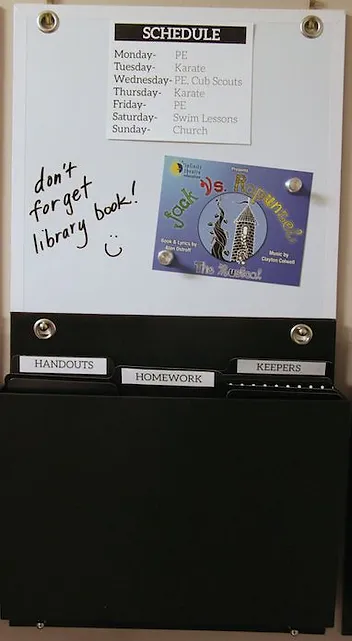
If you want to get a purpose-built schedule board, go with a weekly one. While the monthly ones are tempting, the minute you hit the middle of the month, you’re erasing and rewriting just to see the weeks ahead, and it turns into a chore nobody keeps up with. A rolling weekly view is so much easier to actually live with.
If you’d rather keep the whole thing electronic, a shared family calendar can handle all of this, and now that my kids are older and have their own phones, that’s what we do. We use a shared Google Calendar, but you can also use apps like Skylight Calendar. So many of our clients have it and absolutely love it! You can also incorporate chores with it, so that’s an added bonus.
Start With Backpacks and Bags
What works when your kids are little might no longer work once they’re older, and drop zones are no exception. The trick is to see the change coming and leave room for it. Backpacks and bags are the clearest example of this when it comes to drop zones.


In the preschool and early elementary years, everything is light and easy. A little backpack, a dance bag, a swim bag, a karate tote: all of it hangs happily on a hook. We used to keep everything for karate in one tote on a hook by the door, so when it was time to go, we grabbed the whole thing and left, instead of racing around the house hunting for a missing belt. Keep the gear for each activity together, give it a hook, and you’re set. Grab and go.
By the time your kids are in high school, backpacks can weigh close to 50 pounds, because no one uses a locker anymore. These days, even kids in elementary school have heavy bags because many of them have to tote a laptop to and from school. A bag that heavy will take a hook right off the wall. So even if a hook does the job today, it’s worth carving out a spot that can flex later: a bench, a cubby, or a low shelf sturdy enough to hold a loaded bag when the time comes.
That kind of planning ahead is exactly what we did when we redid our mudroom a few years back. We added custom cabinets designed for the years to come, not just the stage we were in. We still have hooks where the kids can hang their jackets, but there’s a bench underneath for the heavy backpacks, and a shoe shelf instead of baskets, because grown-kid shoes don’t squeeze into a cute little bin. Building in that flexibility meant we weren’t starting over every couple of years.
So as you set up your zone, design a little ahead of where your kids are right now. Leave a shelf that can take more weight, hooks you can move up as they get taller, and bins with room to spare. The drop zone that lasts is the one that already has a little growing room built in.
Max Out Your Hooks
Don’t skimp on hooks! Kids come home with a jacket, a raincoat, and a hoodie they never actually wear but insist on carrying. My favorite drop zone we ever set up for a client had an entire row of hooks marching down the wall. Simple, and it held everything. You can literally never have too many hooks!
A long row of wall hooks or pegs is honestly my go-to solution, and you can find them in just about any style to match your space. We did a really pretty setup for one family with a rail that had hooks, plus little baskets, and other attachments that clipped right on.


To make it easier for your drop zone to grow with your kids, hang hooks at two heights. Put your permanent hooks up where an adult would reach, then add a few Command hooks lower down so little kids can hang and grab their own things without help. That independence is the whole point.
Shoe Storage That Keeps Up With Growing Feet
Shoes are where many drop zones fall apart, because feet keep growing and shoe piles keep multiplying. You’ve got a few good options depending on your space.
When kids are little, I like to have one basket for shoes per child, so nobody’s digging through a shared heap. As kids grow and their shoes get bigger, switch to shoe racks. Metal racks, stacking shelves, and wire racks all work, and they’re just as happy in the garage as in the mudroom.
If you’re short on floor space, get a shoe cabinet, where you tip a shallow drawer forward and slide shoes in. The whole piece isn’t very deep, and you can set a little tray on top for keys, sunglasses, and a wallet. One warning: check your shoe size before you buy, because larger shoes sometimes won’t fit in those slim drawers.
And if you truly have no floor to spare, go vertical. An over-the-door shoe organizer, like the Elfa over-the-door system, or a wall-mounted rack lets you fit a surprising number of pairs on a bit of door or wall you weren’t using anyway.


Give the Little Stuff a Home Too
The big things are easy to plan for. It’s the little stuff that quietly takes over.
For hats, gloves, and scarves, we give each kid a labeled basket or drawer with their name on it, kept low enough for them to reach. In the winter, it holds their winter gear. Come summer, we swap that out for sun hats, sunglasses, and whatever else the warm months call for, and the off-season stuff goes up on a higher shelf until it’s needed again. Easy for kids to grab what they need without hollering for you.
I also like to keep a catch-all bin in the drop zone, because random things pile up no matter what. Pencils, tiny toys, that mystery plastic piece nobody can identify. Give it a container so it stops living on the floor.


Notice what keeps piling up in your own drop zone, and give that thing a home and a label. Maybe it’s library books. Maybe it’s a sports bag. It’ll be a little different for every family, but if you’re reaching for it every day, it deserves a designated spot.
Pro tip: I keep a “returns” basket in my drop zone as a temporary home for anything I need to give back, whether it’s a Tupperware container that belongs to my mom or a bag headed to consignment.
The Drop Zone Secret for Kids With ADHD
If your child has ADHD, or just genuinely struggles to follow through, a visible drop zone works better than anything hidden away. The goal is to make it easy to see where things go and easy to put them back.
That means open containers, not lidded ones. It means a hook instead of a hanger in a closet, because hanging a jacket on a hanger is a real ask for a kid, while dropping it on a hook takes half a second. It means clear bins instead of drawers, so they can spot what they need at a glance.


And don’t fill the whole space with your containers. In a cubby, skip the tall bin that reaches the top, the kind they have to pull all the way out, drop something in, and shove back. Use a container that’s maybe half the height of the cubby, so they can just reach in, grab, and go. Then label everything, big and bold. For younger kids, picture labels work beautifully.
A place for everything, and I mean everything: lunchboxes, homework, library books, the PE uniform, all in a spot they can actually reach and see. That’s what makes a system a kid can run on their own.
The Two Mistakes That Undo Every Drop Zone
Most drop zones fail for one of two reasons.
The first is not giving everything a clear spot to begin with. The second is skipping maintenance. Those tiny shoe baskets fill up in about five minutes, and if nobody ever cleans them out, shoes start spilling onto the floor. Once you get what I call floor creep, it snowballs fast, and the whole area feels overwhelming.
The fix is a simple weekly reset. Your shoe shelf is your boundary. When there are more shoes than will fit on it, that’s your cue to have each person pull the pairs they’re not really wearing and move them somewhere else or donate them. When I see shoes stacking up next to our shelf, everyone comes down and clears their own, leaving just the everyday pair. Maintain it, or it gets out of hand quickly.
The other big mistake is designing storage that ignores how your family actually lives. If you’re a no-shoes-in-the-house family, you need real storage for the number of shoes you own, whether that’s cabinets in the garage or a closet system in the mudroom. A year or two ago I redid our kids’ closets and our entry coat closet specifically to fit everyone’s shoes, and I gave each person a designated spot. Now only my husband’s shoes live in the coat closet, and when that shelf is full, he knows it’s time to donate a pair or move some upstairs. Everyone knows exactly where their everyday shoes belong. (Ours are honestly all in different places, mine near the front door and the kids’ by the back, but that’s just how we move through the house.) Figure out a solution based on the space you have.


Store Things Where You Actually Use Them
This is one of my favorite tricks, and it applies way beyond the mudroom.
We keep all of our socks in the mudroom. Why? Because that’s where the kids put on their shoes, and nobody wants to run back upstairs for socks at 7:30 in the morning. Each kid has their own sock drawer right there next to the shoes.
When my daughter was younger, I did her hair in the kitchen before school, so we kept a drawer in the mudroom with a comb, hair ties, and a water bottle, all in the spot where the thing actually happened. I’ve seen families whose kids brush their teeth downstairs, so they keep a toothbrush and toothpaste in the downstairs bathroom too. Figure out where you really do a thing, and put the supplies for it right there.
Keep It Running All Year
You can set up the most organized drop zone in the world, with the prettiest bins, hooks, and command board, but the setup is only half the job. What actually keeps a drop zone working is a weekly rhythm and slowly handing the reins to your kids.
On Sunday nights after dinner, our family pulls out phones and laptops and syncs the week. We catch the ride we need to arrange, the birthday gift we forgot to buy, and the night everyone’s slammed so we can plan for takeout. It’s also when someone notices, oh, you have a soccer game Wednesday, better make sure the uniform is clean and the cleats are packed. That one pause to look ahead keeps the whole week from turning into a scramble.
When my kids were younger, the schedule on our command board did more than tell me where everyone had to be. It gave them a way to look and think for themselves: oh, I have karate today, I need to grab that bag this morning. As they got older, the reminders became their job, not mine. They’d add a note about a book report due tomorrow or a poster for a project, and set whatever they couldn’t forget right by the back door the night before, so it was impossible to miss on the way out.
Every time a kid takes over one of these little responsibilities, that’s one less thing living in your head. They learn to keep their own sports gear game-ready, and because everything has a home, the hockey bag is always waiting right where it should be.
Because kids and seasons keep changing, plan to revisit the whole zone a few times a year. Swap the winter hats and gloves for sun hats and sunscreen, refresh the schedule when activities change, and clear out whatever the last season left behind. A drop zone that gets a quick seasonal reset is the one that actually lasts all year. Our Membership Program is built for exactly this kind of seasonal refresh.
Frequently Asked Questions
Ready for Calmer Mornings?
A good drop zone is genuinely the room I’d tell you to invest in first, because one organized spot near the door can catch all the clutter that otherwise ends up scattered across your whole house. If you want help building a system that fits your family and your space, our Professional Organizing team works with families all over the Annapolis area to do exactly that. Reach out for a free consultation and we’ll come see your space and make a plan together.
Happy organizing!
Products Mentioned in This Post


ABOUT
Each of my career choices-wedding coordinator, event planner, and teacher — gave me the creative freedom to organize everyone and everything. I have always thrived on to-do lists, planners, and systems! Now, I lead a team of organizers to help me on my mission. Read more…


