New Year, New Systems: 5 Decluttering Methods for Busy Families
It’s 7:47 AM on a Monday in January. You’re hunting for your kid’s other snow boot, stepping over a pile of new Christmas toys that still don’t have homes, and trying not to notice that the hall closet won’t fully close anymore because someone shoved the holiday decorations in there “temporarily” two weeks ago.
Sound familiar?

If you’re feeling that post-holiday overwhelm, that sense that your home somehow shrank over December while the stuff multiplied, you’re not alone. We get it. Our homes aren’t perfect either. We have real families who make real messes, too.
You know that nagging urge to get organized at the beginning of the new year? It’s not just you being hard on yourself. It’s actually your brain doing exactly what it’s supposed to do.
Why January Hits Different
Scientists have a name for what you’re feeling. They call it the Fresh Start Effect.
Researchers at the University of Pennsylvania discovered that certain moments, such as January 1st, the start of a new school year, or moving into a new home, serve as a kind of psychological reset button. These time-based markers and milestones help us mentally separate from our past selves, making us feel ready to tackle new challenges.
And here’s the thing: New Year’s Day is the most powerful of all these fresh-start moments. Your motivation right now? It’s real. It’s backed by science! And it’s worth using.
December probably brought an influx of new toys, clothes, gadgets, and gifts that all need permanent homes. If you added any new holiday decorations this year, you’ve got new storage puzzles to solve. And then what do you do with the gifts that you received but don’t really want? If you’re like the participants of a 2023 study in the UK, you probably shoved them into a cabinet somewhere!
So if your house feels more chaotic than usual right now, it’s not your fault. It’s just… December.
The Part Nobody Talks About
The clutter around you doesn’t just make your home messy. It actually affects how you feel.
A UCLA study tracked cortisol levels in dual-income families and found something surprising: women who described their homes as “cluttered” or “full of unfinished projects” had elevated stress hormones throughout the entire day—not just when they were looking at the mess, but from morning to night.
Psychology Today reports that people living in cluttered environments experience higher rates of anxiety and depression symptoms. And during winter, when we’re spending more time indoors? That impact hits even harder.
This isn’t about having a Pinterest-perfect home. It’s about creating a space where you can actually breathe.
Why This Resolution Might Actually Stick
I know, I know. New Year’s resolutions have a bad reputation. Research suggests nearly 80% are abandoned by February. But here’s why decluttering is different from that gym membership you bought in January 2019 that you’re still paying for today.
First, decluttering delivers immediate, visible results. You can transform a single drawer in 15 minutes and see the difference right away. That’s a dopamine hit that keeps you coming back for more.
Second, it fits into the cracks of busy family life. You don’t need a two-hour block or a babysitter. You need a timer and a trash bag.
And third—this is the part I love—decluttering actually supports your other goals. Want to eat healthier this year? An organized kitchen makes meal prep possible. Hoping to get your finances in order? You can’t manage paperwork you can’t find. Want your kids to make their own lunches? An organized pantry makes that happen.
Lunchtime Decluttering Sessions: Channel your New Year’s energy before “Quitter’s Day” hits. (That’s the second Friday of January, and statistically the day most people give up on their resolutions.) If you are reading this in January 2026 and looking for some support and accountability, join Susie every Friday at lunchtime for a quick 20 minute decluttering session. It’s shocking how much momentum you can create by starting with one small space. You can sign up here.
Find Your Decluttering Style
There is no single “right” way to declutter. What works beautifully for your friend might make you want to throw in the towel by noon.
The secret isn’t finding the best method. It’s finding your method—the one that fits your personality, your schedule, and the way your brain actually works.
So let’s find yours.
If You Need Quick Decluttering Wins: The Drawer Dumping Method
This is my go-to recommendation for anyone feeling overwhelmed, and here’s why: it works fast, and that first taste of success changes everything.
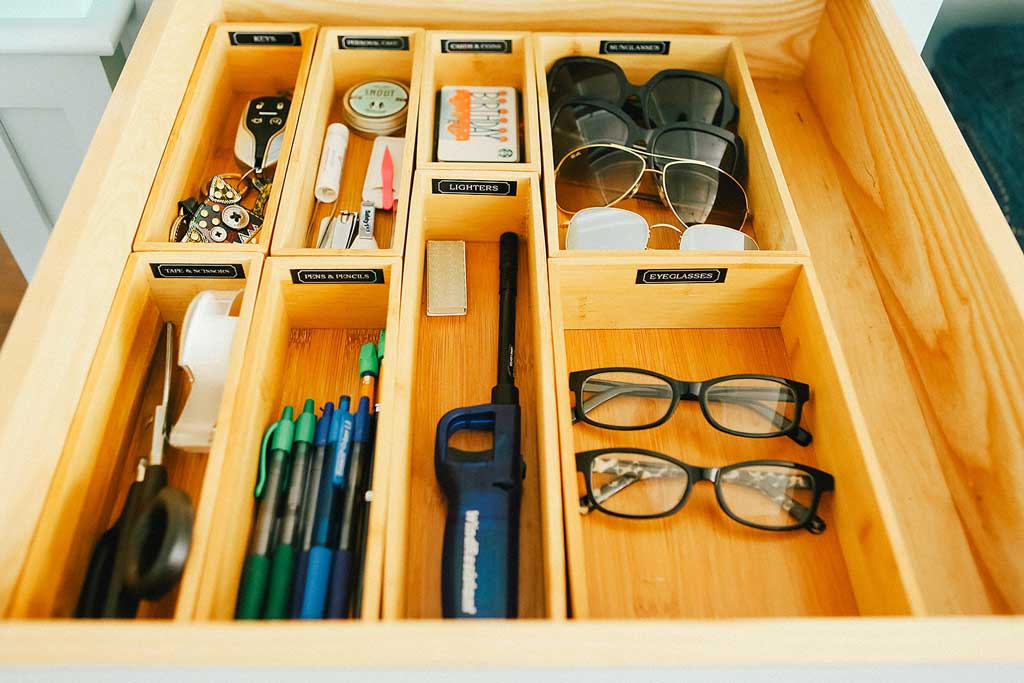
The concept is beautifully simple. Pick a drawer—just one. (I always tell people to start with the drawer that annoys them most. You know the one. The junk drawer you grumble about every single time you open it.) Now, take the entire drawer out, dump everything onto a towel or into a box, and look at what you’ve actually been storing.
Here’s where the magic happens: instead of deciding what to get rid of, you’re going to pick out only the items you actually use and group them into categories. Usually, it’s surprisingly few. Clean that empty drawer, put back only the keepers, and donate or trash the rest.
That’s it. In fifteen to thirty minutes, you’ve got one space that works perfectly. One drawer that doesn’t make you cringe. One small corner of your home that’s completely under control.
The transformation is immediate. And trust me, that feeling of opening a drawer and finding exactly what you need, right where it should be? It’s addictive in the best possible way.
Best for: Junk drawers, kitchen utensil drawers, bathroom vanities, utility closets, kids’ sock and underwear drawers, coat closets, nightstands
If You Want the Kids Involved with Decluttering: The Four-Box Method
When you need a system the whole family can understand—including the seven-year-old who insists every broken Happy Meal toy is a “treasure”—the Four-Box Method is your friend.
Set up four containers, clearly labeled: KEEP, DONATE, TRASH, and RELOCATE (for items that belong in a different room). That’s it. Those are your only options.
Now, pick a starting point—one corner, one shelf, one drawer—set a timer, and work your way through systematically. Pick up each item, decide which box it belongs in, and place it in that box immediately. Every single item goes into one of the four boxes before you move on to the next.
One of the keys to making this work is to remember there are only four boxes! There’s no “maybe” box. I know it’s tempting to create a fifth category for things you’re not sure about, but that pile becomes a black hole where decisions go to die. Remember, clutter is really just delayed decisions. Every item has to go somewhere. Pick it up, make a choice, move on.
For families, this becomes a game. Can we fill the DONATE box before the timer goes off? Who can find the most items that belong in a different room? Kids as young as four can participate with picture labels on their boxes—and there’s something powerful about children learning that letting go isn’t scary.
One crucial rule: when those boxes fill up, process them immediately. Put the KEEP items away properly. Load the DONATE box directly into your car (not the garage, where it will sit for six months). Take the TRASH out right now. Walk the RELOCATE items to their proper rooms before you forget.
If You Struggle with “But I Might Need It Someday”: The 90/90 Rule
We’ve all been there. You’re holding something you haven’t touched in two years, but your brain starts spinning elaborate scenarios where you’ll definitely need this exact item someday.
The Minimalists created the 90/90 Rule specifically for this mental trap. Ask yourself, “Have you used this item in the last 90 days? Will you use it in the next 90 days?”
If the answer to both questions is no, let it go.
What I love about this approach is that it cuts through the emotions with cold, hard facts. The 90-day window is long enough to account for seasonal changes (so you’re not donating your winter coat in July), but short enough to be honest about what you actually use versus what you’re keeping “just in case.”
This method works especially well for kitchen gadgets (that avocado slicer you used once in 2020), craft supplies (the scrapbooking phase that never quite took off), and toys (the ones that haven’t been touched since their novelty wore off three days after Christmas).
Family modification: For kids’ items, you might adjust to a 6-month window with simpler questions: “Have you played with this in the last month? Will you play with it this week?”
If You’re Drowning in Busy: The 15-Minute Method
Maybe you read “dump everything onto a towel” in the Drawer Dumping Method section and thought, With what time, exactly?
I hear you. When you’re juggling work deadlines, school pickups, dinner prep, and the general chaos of family life, carving out hours for a decluttering project feels impossible. That’s where the 15-Minute Method comes in.
One of my organizing friends, Shira Gill, created a viral Instagram hashtag for #15minutewins. This approach is exactly what it sounds like: set a timer for 15 minutes, pick a single task or small area, and do what you can in 15 minutes. Your only job is to stay focused for the whole 15 minutes. When the timer goes off, you are free to stop. Or, keep going if you’re on a roll.
Then do it again tomorrow, in a different area.
Here’s why this works when nothing else has: decision fatigue is real. Your brain can only make so many choices before it starts shutting down. Fifteen minutes is right in the sweet spot—long enough to make meaningful progress, but still short enough that you won’t burn out.
And those minutes add up. Fifteen minutes a day is nearly eight hours of decluttering per month. That’s significant.
Pair your 15-minute session with something you already do, like right after the kids go to bed, while dinner is in the oven, or during that window when you’d normally scroll your phone. Make it automatic, and you won’t have to rely on motivation that comes and goes.
If Your Family Loves Competition: The 30-Day Minimalism Game
Ready for something more dramatic? The 30-day Minimalism Game is a challenge that removes 465 items from your home in one month.
Here’s how it works: On Day 1, you remove 1 item. On Day 2, you remove 2 items. On Day 3, 3 items. And so on, all the way through Day 30, when you’re finding 30 things to let go.
For competitive families, this is gold. Create a family leaderboard. See who can find their items fastest. Make it a race to the donation bin. Celebrate Day 30 with a special activity. You’ve earned it!
I’ll be honest with you: Days 20-30 get challenging. Finding 25+ items to remove in a single day requires commitment. This game works best for families with significant clutter and want a dramatic jump-start, not for homes that just need fine-tuning. It’s also best for those who can stick with a daily routine.
Want a Day-by-Day Decluttering Plan? Try Our 30-Day Challenge
If you like having everything mapped out—knowing exactly what to tackle each day without having to think about it—we’ve got you covered. Our Systems by Susie 30-Day Family Decluttering Challenge walks you through a different space each day, from kitchen counters to coat closets to that mystery box in the basement you’ve been avoiding since you moved in.
Just follow along and check off each day. No decision fatigue about what to do next.
Quick Reference: Which Decluttering Method Fits You?
| If you’re thinking… | Try this method |
| “I just need a win to get started” | Drawer Dumping |
| “I want the whole family involved” | Four-Box Method |
| “I keep everything ‘just in case'” | 90/90 Rule |
| “I literally have 15 minutes, max” | 15-Minute Method |
| “We need a serious reset” | Minimalist Game |
| “Just tell me what to do each day” | 30-Day Challenge |
Want to Kick Off January with Some Guidance?
Join us for our FREE January 2026 Decluttering Lunchtime Series!
We’re hosting live Zoom decluttering sessions every Friday of the month to help you start the year organized and motivated. Get real-time tips, ask questions, and join Susie and others who are right there with you.
Sign up for the January Lunchtime Series
Your Fresh Start Begins with One Drawer
You don’t have to do everything at once. You don’t have to be perfect. You don’t have to transform your entire house this weekend.
You just have to start.
Pick one method from the list above—whichever one made you think, “Okay, I could actually do that.” Set a timer for 15 minutes. Start with the drawer that annoys you most, or the corner that’s been bugging you for months.
See how it feels.
Decluttering isn’t really about having a cleaner house, though that’s a lovely side effect. It’s about reducing the mental load that clutters your brain. As Gretchen Rubin says, “Outer order equals inner calm.” It’s about creating space to breathe. It’s about spending less time managing stuff and more time on what actually matters to your family.
That January motivation won’t last forever. But the systems you build now? Those will carry you through the entire year.
If this feels like too much to tackle alone, you’re not alone. That’s exactly what we’re here for. Our team specializes in helping busy Maryland families create systems that actually stick—with kindness, empathy, and zero judgment. We’ve seen it all, and we’re here to help, not criticize.
Your fresh start is just one phone call away.
Frequently Asked Questions
Ready for the Next Step?
You’ve got your method. You know why January is the perfect time to start. Now comes the real question: once you’ve decluttered, how do you make it last?
Because here’s the truth nobody tells you: the decluttering itself is actually the easy part. The magic (and the challenge) is creating systems that keep the clutter from creeping back in. Plus, you need to actually get those donation bags out of your house before someone rediscovers their “treasures.”
In Part 2 of this guide, we cover:
- The 5 mistakes that trip up even the most motivated families
- Daily, weekly, and seasonal habits that prevent re-cluttering
- Our favorite Maryland donation spots (so you know exactly where to take everything)
Read Part 2: After the Declutter—How to Make It Last (And Where to Donate in Maryland)
But first? Pick your method, set a timer for 15 minutes, and start with one drawer. You’ve got this.

ABOUT
Each of my career choices-wedding coordinator, event planner, and teacher — gave me the creative freedom to organize everyone and everything. I have always thrived on to-do lists, planners, and systems! Now, I lead a team of organizers to help me on my mission. Read more…